Welcome to my Bird Blog!

Welcome to all my fellow bird lovers and gardeners! I'm so glad you stopped by.

Migratory bird populations have taken a nose dive in the past 40 years. But you can help bring their numbers back by creating beneficial, beautiful and fun habitats in your own backyard. Discover favorite plants and environments that shelter and feed colorful songbirds, as well as how to make them feel welcome by offering their preferred natural foods.

Grandma Pearl
(Connie Smith)
Showing posts with label Finches. Show all posts

Thursday, February 27, 2014

Secrets to Attracting Flocks of Happy Finches to Your Yard

Male Purple Finch (a/k/a Raspberry Finch)


Such energy and color!  I love finches: goldfinches, house finches, purple finches, crossbills, red polls, evening grosbeaks, and pine siskins.  They range from greens, to yellows, to oranges to raspberry red, and they have wonderful liquid songs that uplift the spirit.  You cannot help but be happy when finches are around.

On top of that, they eat a ton of weed seeds!  Their favorite seeds come from the thistle, also purple cone flowers, iron weed, dandelions, asters, cosmos, zinnias, and of course, sunflowers.  Once in a while they will eat a bug, but they are granivorous as a rule.

People so enjoyed their color and lovely songs that purple finches and house finches were once sold as caged birds!   To please either of these finches, plant cherry trees.  House finches in particular have a sweet tooth.  When hummingbirds aren't looking, they will steal some of their nectar! 

American Goldfinches Male and Female, Mourning Doves in the foreground.
by Grandma Pearl

American goldfinches delay raising a family until late summer to coincide with the ripening of the seeds they love.  They feed only seeds to their young, rather than any bugs or protein.  Their song and color is so beautiful that they are known as 'wild canaries'.  In the wintertime, they burrow under the snow for insulation against the cold.


This winter I have had mixed flocks of finches that have numbered in the hundreds!  I know because I participated in the annual Great Backyard Bird Count, as I do every year.  I'm sharing my secrets for finch success so that you may enjoy the colors and music of these awesome little birds.
Goldfinches in their winter plumage, lining the tree branches, waiting their turn at the feeders.
by Grandma Pearl

The Best Feeders for Attracting Colorful Finches:


Male House Finch enjoying a sunflower seed.
by Grandma Pearl


These little finches love to swing as they pluck seeds from this easy-to-make Basket Feeder
by Grandma Pearl

Best Foods for Attracting Finches:

  • Nyjer (Thistle) seed
  • Black Oil Sunflower seed
  • Peanut Hearts
  • Suet
  • White Proso Millet
  • Fruit
  • Cracked Corn
  • Rock Salt or Salt Block
  • Sugar Water (hummingbird nectar)

If you only have room for one or two feeders, or your bird feeding budget is small, choose the tube-style feeders:  one for thistle seed and one for black oil sunflower seed.  You may also wish to add a heavy dish in which to put a few small pieces of apples that have been coated in sugar water.  What a treat for your finches to enjoy when it's cold outside!

A block of salt placed on the ground, or a handful of rock salt scattered under the feeders, will also please your chatty little finches.  You can also toss handfuls of sunflower seed over the snow.  As they forage, they will pick up water from the snow to help with their digestion.

American Goldfinches foraging for sunflower seeds in the snow.
by Grandma Pearl


All birds need a source of grit, or tiny stones that they use in their crops to help grind up their food.  They don't have the stomach acids we do, so that is how their food is broken down for use in their bodies.  You can find a small bag of bird sand or grit at the pet store.  It's an inexpensive way to help out all your birds, especially in the wintertime when snow covers the ground where they would normally find the fine grit they need.

Make sure to keep your tube feeders very clean.  If you should find mold in the seed tubes, dump them out immediately.  Then clean your feeders with a solution of 9 parts of warm water to 1 part of household bleach.  This will kill any bacteria that would otherwise cause harm to your birds.  Make sure the tube feeder is thoroughly dry before refilling and re-hanging.  By the way, a long-handled narrow brush is useful for cleaning tube feeders.

Mold is also a sign that birds are not eating as much seed as you have put out.  Try starting with a smaller amount of seeds in a tube feeder until your finch flock expands as the word gets out around the neighborhood!

Also, don't allow seeds to accumulate under the feeders.  Mold and bacteria from droppings can develop.  Finches love to forage on the ground, and you don't want them to get sick or worse.  I use a leaf vacuum to suck up all those spent bird seeds shells; then I toss them into the garbage.  It isn't wise to use them as compost because sunflower seeds in particular do not get along well with other plants.  In short, they poison them, which can cause some nearby plants to be deformed or die altogether

Enjoy your fascinating flocks of finches.  I guarantee they will put a smile on your face!


Saturday, August 10, 2013

What's the Difference Between a Purple Finch and a House Finch?

Male Purple Finch and Male House Finch Share the Same Tree
by Grandma Pearl
Just 2 days ago I was fortunate enough to notice both a male purple finch and a fledgling male house finch sharing the same tree branches.  If you look closely, you can see some of the differences in coloration and where it occurs on each bird.

Male purple finches (he's on the upper left side of the above picture) have a bright raspberry colored head, chest and rump.  When the sun's rays strike that rose hue just right, you're hit with the most beautifully intense rose red that is amazingly vibrant. 

House finches sport a brown patch behind their eye, and they have a brown upper back and wings.  Brown streaks mark the house finch's chest, while the male purple finch has no brown streaks on its chest.  Male house finches show a more reddish-orange coloration, which can vary through the orange shades and into the yellow spectrum, depending upon how many carotenoids they have ingested from their food. 

Their neck and upper chest, rump and stripe above the eye, and forehead are all orange.
Note, too, the difference in the tails.  Purple finches have a more deeply notched tail; house finches have a more square-shaped tail with just a slight notch.

The lovely warbling songs of the purple finches always brighten my day, especially when springtime is at hand.  House finches, on the other hand, have a less harmonious song, I think, than the purple finches.  It is, however, joyful and as bright as their warm orange color.  Both of these finches are very close in size, with the house finch being just a tad smaller at about 5-3/4 inches.

In both the purple finch and the house finch, females are heavily streaked.  House finch females are a lighter shade of brown with a brown head.  Purple finch females have a white streak behind their eye and a brown patch on their cheek.

The little house finch fledgling in my picture is just learning how to fly by making short hops from bush to tree branch.  One of the first places I saw him land, albeit a little awkwardly, was the tube seed feeder.  There he perched and dined for quite some time.  Occasionally he traded one perch for another, but seemed to be comfortable on that feeder.
Grandma Pearl

Fledgling Male House Finch Enjoys Sunflower Seeds
by Grandma Pearl

Sunday, June 2, 2013

Finches Come In All the Colors of the Rainbow!

Remember that old mnemonic for the colors of the rainbow?  
R O Y G B I V representing Red—Orange—Yellow—Green—Blue—Indigo—Violet


Well, members of the finch family represent all those colors and more.  These seed and fruit loving birds literally come in all the colors of the rainbow!  Beautiful and musical, Mother Nature has created finches for our pleasure.  They are most helpful when ridding us of weed seeds, and serenading us with their cheerfully expressive songs. Smaller finches range in size from 5 to 6”, while grosbeaks are the largest at 8”.

Male Purple Finch
by Grandma Pearl


Blue Grosbeak from Dan Pancamo, flickr.com, cc-by-sa
The Purple Finch, also known as Raspberry Finch, and the Blue Grosbeak are just two of the colorful members of the rainbow.  Can you guess which finch is yellow? violet? orange?
Find out Here


With all the rain we've had lately, my gardens have exploded with colorful blooms!  I love to use flowers and plants that attract birds, butterflies and beneficial insects.  Adding to the native wildflowers and bushes that my resident birds recognize and that are familiar to them, keeps my yard flowering all season long.
variegated pink and white weigela bush
by Grandma Pearl
Variegated pink and white weigela bush is a hummingbird magnet.  It also attracts butterflies and bees.  I'm in zone 5 and it has always been hardy here.  It will bloom for about a month, and last year it bloomed again toward the end of the summer!  The blossoms start out pink and then turn white with blush pink centers.  I have several weigela bushes, and the hummers are in and out of them constantly all day long.


white weigela blossoms--hummingbird magnets
by Grandma Pearl
My oregano in one part of the herb garden.
Grandma Pearl
When the oregano flowers in late summer, it attracts lots of beneficial insects and bees, plus butterflies.  It's a very popular plant.  I use this herb all the time in cooking and salads.  In the foreground is golden oregano, in the background near the lattice is regular oregano.  There is also monarda, or bee balm, just starting to grow.  Bee balm is another hummingbird magnet, and it attracts butterflies and bees.  I love the smell of it, and I can always tell when the bees or hummers are working it.  The aroma is wonderful!

Grandma Pearl

See the newest Rustic Bird Houses made from antique reclaimed barnwood HERE

Wednesday, May 1, 2013

Gold Finches on a Sunny Yellow Day

Male American Goldfinch at sunflower seed tube feeder
by Grandma Pearl
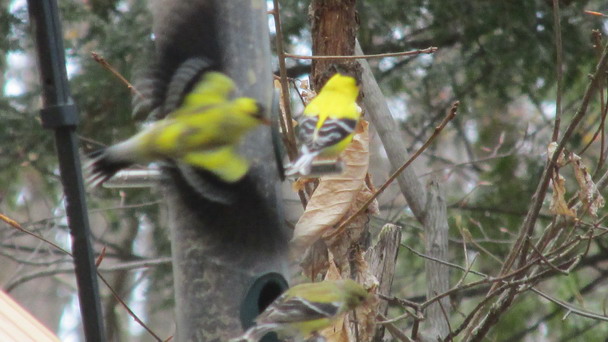
I call them drops of sunshine!  American Goldfinches  are a familiar and welcome sight.  The bright yellow and contrasting black plumage of the males is distinctive.  They use both the sunflower tube feeder and the nyjer or thistle tube feeder, often lining up in the nearby trees waiting for their turn.

Nyjer Thistle Seed Tube Feeders
 These guys travel in flocks and are very social and sociable.  I love to here their 'zee-zee-zeet' call as they fly in for food.  I planted coneflowers and joe pye weed so they would have lots of natural seed sources in the fall.  
Male American Goldfinch, Female Goldfinch and Goldfinch in flight
by Grandma Pearl
Yellow Double Tulips add to the Sunshine This Morning
by Grandma Pearl
What's your favorite color in nature?


Diminutive in size at about 5", they make their presence known as they chat among themselves at the feeders.  The female in breeding plumage is a duller olive green-grey color, but I think just as beautiful in her own way as the male.  She will lay 4 or 5 light blue eggs in her nest of grass and dandelion down.

Dandelion fluff, incidentally, is used by a number of birds to line their nests and cushion their eggs.  Just this morning I saw a chickadee with a beakful!
Am I the only one who thinks dandelions are pretty?
by Grandma Pearl


White-Throated Sparrow-Morphed with Yellow Spots above Lores
by Grandma Pearl
This White-Throated Sparrow sports bright yellow
spots above the lores; and white and black stripes on its head.  Yellow spots denote the morphed version.  The white throat is easily visible in this picture.  These sparrows love to forage on the ground for seeds and small insects.  Their call sounds like 'sweet, sweet, Canada, Canada, Canada.'  Measuring about 6 1/2" they  prefer to flock and roost in thickets or hedges at night.
Narcissus with Yellow Trumpet
by Grandma Pearl
What's your favorite color in Nature?
Grandma Pearl


Sunday, March 31, 2013

Happy Easter!

On this overcast Easter Day my birds are busily flying back and forth to and from the feeders; chickadees, nuthatches, titmice, woodpeckers, juncos and blue jays, as well as red polls and gold finches.  I can't wait for the gold finches to shed their winter coats and don their bright yellow sunshine feathers. 
Goldfinches on Tube Feeder
photo by Grandma Pearl


Yes, spring is on its way even if the temperature is below average and the sun chose not to shine today.  The birds seem not to care a bit.  The robins are calling for rain, which is in the forecast by the way; the nuthatches are combing the trees and the Little Brown Creeper haltingly works its way upward, spiraling around the tree in search of a juicy meal.

I heard the dawn chorus yesterday morning, for the first time this year. I'm thinking the birds know something I don't, so my hopes are for a real change in the weather coming soon! 
Crocus photographed by Grandma Pearl

HAPPY EASTER!
Grandma Pearl


Log Cabin Bird House with Stone Chimney
from rusticbarnwoodbirdhouses.com


Monday, January 14, 2013

What Are These Little Birds?

Add caption

What in the world are these small colorful birds, and why have they descended on my backyard in the middle of winter?  I was intrigued by the size of the flocks, and enchanted by their ‘sweet’ song.  They were so tame, I literally walked among them!  They turned out to be Common Redpolls, but I found them to be anything but common.

It was just after Christmas in the middle of a snowstorm that dumped over a foot of snow here.  I heard the excited chirps high in the tree tops while I was shoveling my way to the woodshed.  They were small birds, and there were myriads of them!  Perched in the dark grey branches on a cold, grey day I found it hard to pick out any colors at all.  Besides that, my glasses would become covered with snow every time I looked upward!
We usually have large flocks of goldfinches that hang around all winter.  That was my first guess, and my second guess was purple finches.  I had read in Audubon magazine that this might be a good year to see purple finches during the winter time.  Although I had seen several purple finches the week before, these did not sound like the lovely and bubbly purple finches that usually appear in spring.  Nor did they say “zeee-zee” as do the goldfinches.  Having finally reached the woodpile, I gathered up enough wood for the day and headed back to the warmth of the house.  By then my fingers and toes were frozen, and my one thought was to start a fire and warm up.
The next day the sun was shining intermittently.  As I glanced out toward the bird feeders I noticed that all 6 of them were loaded with small birds.  It was time to fill the feeders anyway, so I again grabbed my shovel and worked my way out to the hungry birds.  By now they were covering the ground beneath the feeders searching for morsels on the snow.
These friendly little guys didn’t mind my presence at all.  In fact I had a couple of them fly so close as to feel the air from their wing beats.  The nearer I came the more I realized that these were definitely not goldfinches.  Nor were they the purple finches I had seen a week earlier.  In fact, I had never seen these birds in person before in my life.   Read more


Grandma Pearl