|
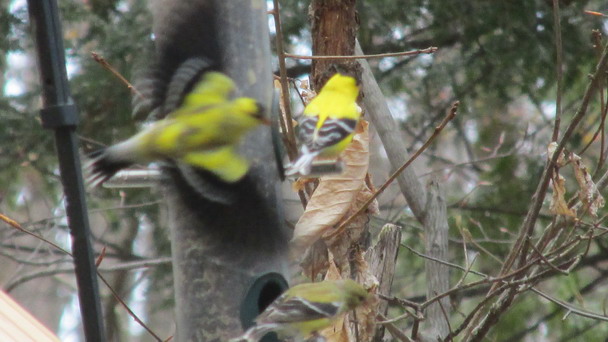
| A variety of birds enjoying a variety of bird feeders. Image by Grandma Pearl |
Some of My Happy Birds!
There are 5 birds in my picture above; can you find them all? (Hint-the head is not visible on one of them.)
By the way, my bird feeder 'post' is actually an old speed bag holder my husband found alongside the road. He thought he would eventually buy a new speed bag and use it, but I had other ideas! It worked perfectly to hold a variety of feeders, and it has a heavy enough base so there is no danger it will fall over in the wind. My husband actually thought I was quite clever! Evidently, he wasn't all that keen on using it himself after all.
I have several more feeders in another part of the yard, but these seem to be the favorite for many of my birds. Instead of suet or peanut butter plugs, I use an offset spatula (the kind used for spreading cake icing) to fill the holes of the cedar suet log

 (Suet Log Bird Feeder)
 with chunky peanut butter. It was a hit from day 1!
The metal mesh feeder (No/No Red Seed Ball Wild Bird Feeder - RSB00343)
 fills from the top and is also extremely popular with the smaller birds in my yard. I have to fill it every 3 days! They enjoy clinging to the mesh and swinging back and forth as birds land and fly off the round feeder. I have also used these in my bird feeder wreaths, which keep the birds from colliding with my front windows.
And then there is the suet holder. There is always at least one bird working at the suet. It might be a woodpecker or a chickadee, a nuthatch or a titmouse. It is occupied from dawn to dusk, especially in the colder weather. All these feeders are inexpensive and draw a variety of birds to my yard in all seasons.
When there is fresh snow on the ground, I enjoy tossing sunflower seeds out for my ground feeding birds. It's a joy to watch them gather and feed where I can observe them at close range.
Gold finches and juncos are the first ones on the scene; they snatch up the seeds on the freshly fallen snow but never seem to have any squabbles among themselves. It's not a good idea to scatter seeds on the ground if you have outdoor cats that might prey on your birds.
I plan on making a snowman when we have enough wet snow. Then I'll add a dish to hold bird seeds and watch as my backyard birds have fun with their newest feeder!
This tube style feeder (Aspects 392 Quick-Clean Seed Tube Feeder, Medium - Brushed Nickel) in another part of the yard is always popular with goldfinches, titmice, chickadees, and purple finches. In the cold months I fill it with a combination of black oil sunflower seeds and a fruit and nut mixture I found at the local tractor supply store. That mixture also contains a little gravel to help the birds digest their food.
The more variety of feeders and types of food, the larger the variety of birds you will attract. Also, don't forget to provide unfrozen water in your bird bath. Those birds get thirsty and need to drink and bathe all year round, not just in the warmer months.
Grandma Pearl
Best Feeders for Winter Birds
How Do Birds Stay Warm?
Myths About Wild Birds
Easy Ways to Provide Water in the Winter
When there is fresh snow on the ground, I enjoy tossing sunflower seeds out for my ground feeding birds. It's a joy to watch them gather and feed where I can observe them at close range.
 |
| Goldfinches and juncos searching in the snow for sunflower seeds. Image by Grandma Pearl |
I plan on making a snowman when we have enough wet snow. Then I'll add a dish to hold bird seeds and watch as my backyard birds have fun with their newest feeder!
 |
| Goldfinches are among the many birds that enjoy tube style seed feeders. image by Grandma Pearl |
in another part of the yard is always popular with goldfinches, titmice, chickadees, and purple finches. In the cold months I fill it with a combination of black oil sunflower seeds and a fruit and nut mixture I found at the local tractor supply store. That mixture also contains a little gravel to help the birds digest their food.  |
| My snow-covered bench--Guess I won't be sitting there anytime soon! Image by Grandma Pearl |
Grandma Pearl
Best Feeders for Winter Birds
How Do Birds Stay Warm?
Myths About Wild Birds
Easy Ways to Provide Water in the Winter