Welcome to my Bird Blog!

Welcome to all my fellow bird lovers and gardeners! I'm so glad you stopped by.

Migratory bird populations have taken a nose dive in the past 40 years. But you can help bring their numbers back by creating beneficial, beautiful and fun habitats in your own backyard. Discover favorite plants and environments that shelter and feed colorful songbirds, as well as how to make them feel welcome by offering their preferred natural foods.

Grandma Pearl
(Connie Smith)
Showing posts with label feed birds. Show all posts

Tuesday, April 1, 2014

Why You Need to Keep Feeding the Birds in the Springtime


Help Out Mom  & Pop!

Adult birds work their feathers off providing protein-rich insects and creepy crawlies for their offspring.
Offering easy meals at the bird feeder helps them tremendously.  They don't have to spend time and energy foraging for themselves, and they can devote more time to poking good stuff down their babies' throats!
So make it easy on your poor mom and pop birds, and continue to feed them until their babies have 'flown the coop'.
If you have bears in your area, they will be waking up about now, too.  So I totally understand if you have no choice but to hide your bird feeders from the big hungry animals!
Otherwise, do make sure your feeders are well stocked during this critical time in your birds' lives.

Grandma Pearl

Photo Attribution:  https://www.flickr.com/photos/harpers/2507688238/


Thursday, February 27, 2014

Secrets to Attracting Flocks of Happy Finches to Your Yard

Male Purple Finch (a/k/a Raspberry Finch)


Such energy and color!  I love finches: goldfinches, house finches, purple finches, crossbills, red polls, evening grosbeaks, and pine siskins.  They range from greens, to yellows, to oranges to raspberry red, and they have wonderful liquid songs that uplift the spirit.  You cannot help but be happy when finches are around.

On top of that, they eat a ton of weed seeds!  Their favorite seeds come from the thistle, also purple cone flowers, iron weed, dandelions, asters, cosmos, zinnias, and of course, sunflowers.  Once in a while they will eat a bug, but they are granivorous as a rule.

People so enjoyed their color and lovely songs that purple finches and house finches were once sold as caged birds!   To please either of these finches, plant cherry trees.  House finches in particular have a sweet tooth.  When hummingbirds aren't looking, they will steal some of their nectar! 

American Goldfinches Male and Female, Mourning Doves in the foreground.
by Grandma Pearl

American goldfinches delay raising a family until late summer to coincide with the ripening of the seeds they love.  They feed only seeds to their young, rather than any bugs or protein.  Their song and color is so beautiful that they are known as 'wild canaries'.  In the wintertime, they burrow under the snow for insulation against the cold.


This winter I have had mixed flocks of finches that have numbered in the hundreds!  I know because I participated in the annual Great Backyard Bird Count, as I do every year.  I'm sharing my secrets for finch success so that you may enjoy the colors and music of these awesome little birds.
Goldfinches in their winter plumage, lining the tree branches, waiting their turn at the feeders.
by Grandma Pearl

The Best Feeders for Attracting Colorful Finches:


Male House Finch enjoying a sunflower seed.
by Grandma Pearl


These little finches love to swing as they pluck seeds from this easy-to-make Basket Feeder
by Grandma Pearl

Best Foods for Attracting Finches:

  • Nyjer (Thistle) seed
  • Black Oil Sunflower seed
  • Peanut Hearts
  • Suet
  • White Proso Millet
  • Fruit
  • Cracked Corn
  • Rock Salt or Salt Block
  • Sugar Water (hummingbird nectar)

If you only have room for one or two feeders, or your bird feeding budget is small, choose the tube-style feeders:  one for thistle seed and one for black oil sunflower seed.  You may also wish to add a heavy dish in which to put a few small pieces of apples that have been coated in sugar water.  What a treat for your finches to enjoy when it's cold outside!

A block of salt placed on the ground, or a handful of rock salt scattered under the feeders, will also please your chatty little finches.  You can also toss handfuls of sunflower seed over the snow.  As they forage, they will pick up water from the snow to help with their digestion.

American Goldfinches foraging for sunflower seeds in the snow.
by Grandma Pearl


All birds need a source of grit, or tiny stones that they use in their crops to help grind up their food.  They don't have the stomach acids we do, so that is how their food is broken down for use in their bodies.  You can find a small bag of bird sand or grit at the pet store.  It's an inexpensive way to help out all your birds, especially in the wintertime when snow covers the ground where they would normally find the fine grit they need.

Make sure to keep your tube feeders very clean.  If you should find mold in the seed tubes, dump them out immediately.  Then clean your feeders with a solution of 9 parts of warm water to 1 part of household bleach.  This will kill any bacteria that would otherwise cause harm to your birds.  Make sure the tube feeder is thoroughly dry before refilling and re-hanging.  By the way, a long-handled narrow brush is useful for cleaning tube feeders.

Mold is also a sign that birds are not eating as much seed as you have put out.  Try starting with a smaller amount of seeds in a tube feeder until your finch flock expands as the word gets out around the neighborhood!

Also, don't allow seeds to accumulate under the feeders.  Mold and bacteria from droppings can develop.  Finches love to forage on the ground, and you don't want them to get sick or worse.  I use a leaf vacuum to suck up all those spent bird seeds shells; then I toss them into the garbage.  It isn't wise to use them as compost because sunflower seeds in particular do not get along well with other plants.  In short, they poison them, which can cause some nearby plants to be deformed or die altogether

Enjoy your fascinating flocks of finches.  I guarantee they will put a smile on your face!


Sunday, January 19, 2014

Make an Easy Basket Bird Feeder

another view of chickadee on bird feeder basket excellent

The snow was falling hard and fast.  Accumulations were predicted to reach an inch per hour, if not more.  Apparently my birds knew about this ahead of time, because there were dozens of them lining the tree branches awaiting their turn at the feeders.finches on feeders and in trees
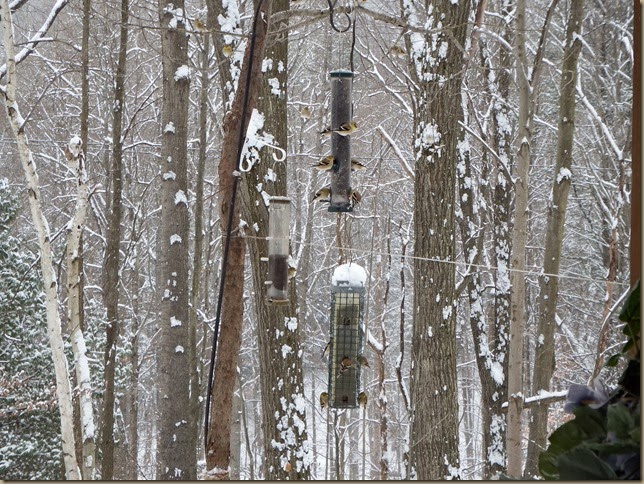
I needed to add another place for them to eat, but I had no more feeders handy.  Keep in mind that there are 8 more feeders in other parts of my yard that were also filled with woodpeckers, chickadees, titmice, nuthatches, blue jays, juncos and more finches, among others!close up of basket to use for bird feeder

Scratching my head, I finally came up with a solution that I had stashed in my sunroom—an old basket with a long handle, and not too deep.  The perfect bird feeder because it was rather loosely woven, and provided plenty of holes for drainage.

closeup of bird feeder basket with aluminum plate filled with seedsBut the holes in the basket were obviously way too big to keep my bird seed from falling through.  Aha!  Also in my sunroom was an aluminum pie pan I had used under a large pot at one time.  I washed the pie pan thoroughly and dried it so that the seeds would not mold.  The pie pan needed drainage holes, so I hunted up my trusty hammer and a small nail.  I punched several holes in the aluminum pan, and filled the bottom with black oil sunflower seeds and a little bit of fruit and nut seed mixture.

basket bird feeder hanging from clothesline with weather shield

I looped a flexible piece of wire under the handle and up through the hole in a weather shield I had used before for other open bird feeders.  That shield works very well to keep snow and rain from soaking the seeds.  Then I finished the loop over my clothesline.  If I had had another bird feeder pole, I would have used that instead, but the clothesline was very handy and easy to see from my living room window.

An alternative to the weather shield might be another larger aluminum pie pan with a hole punched in the middle, or even an old aluminum pizza pan.  Anything that will keep the seeds dry so the birds can enjoy them will work.

gold finches enjoying their basket bird feeder

I was very pleased to see some of my goldfinches taking advantage of their new food source.  I have even had woodpeckers jump in for a seed or nut and then take off to the nearest tree with its treat.  I spent a lot of time that day watching my birds out the window.  There were breaks in the snowfall at times, but it snowed heavily other times.  The birds didn’t seem to mind, and continued to visit all the feeders.  It tickled me to see that I had provided yet another good spot for them to eat.

So if you have a basket, an aluminum pie plate, hammer, nail, pizza pan and a bit of wire, you have the makings for a fun bird feeder!

Enjoy!

Grandma Pearl

How to Make a Bird Nesting Basket

Make a Bird Feeder Wreath

Are Your Bird Feeders Ready for Winter?

How to Feed Birds Without Going Broke

Tuesday, November 19, 2013

New Ideas For Feeding Birds in the Wintertime

Blue Jay at my feeder last winter
Grandma Pearl

Some unique bird feeding ideas from Birds & Blooms magazine, and me!

I have always fed my backyard birds all winter long.  In fact, I feed them year round!  Standard bird feeders are great, but I recently found a couple of different ideas for feeding birds from the newest Birds & Blooms magazine (december/january 2014), and thought I would share them with you.

A fun natural bird feeder involves making a snowman!  from Connie Banet Miller of Wolcottville, IN comes this great idea:
Build a snowman, give him a wide-brimmed hat and fashion some hands.  Add sunflower seeds to the hat brim and to the palms of his hands.  She says she has been able to get some great images of birds eating out of the palms of the snowman's hands!

Lindy Franklin of Plano, TX fills up paper cups with bird seeds and then tosses the cups out on top of the fresh snow.  I can imagine how much fun it would be to watch the birds retrieving goodies from the paper cups!

I like to save egg shells for the birds to use as seed holders.  My husband is a big egg eater, so there are always tons of egg shells around here.  After I wash them out and let them dry, I add bird seed mixed with fruit and nut bird mixture, place them on the tray feeder and watch the birds as they discover their treats.  The blue jays especially seem to love to carry off the empty shells!

In the fall when the acorns are plentiful, I collect the extras to store in a cool, dry place.  When snow covers the ground, I toss the acorns on top of the snow under the bird feeders.  Squirrels are happy to have the nuts, and sometimes I am lucky enough to attract some wild turkeys this way!
Grandma Pearl

Meet 'Persistent Q. Squirrel', always ready to grab a free handout!
Grandma Pearl

Friday, November 15, 2013

Homemade Peanut Butter Bird Treat Recipe


Nuthatch loves homemade peanut butter treat
from Grandma Pearl

Birds Can't Resist This Peanut Butter Treat!

Very Best Easy Peanut Butter Bird Treat

Prep. Time:  5 min.
Cooking Time:  15 min.
Total Time:  20 min.

Ingredients:

* ½ c. crunchy or smooth peanut butter
* ½ c. shortening
* ½ c. flour
* 1-½ c. cornmeal
* ½ c. cracked corn
* ½ c. black oil sunflower seeds
* ¼ c. raisins or currants
* ¼ c. dried apricots, apples or cherries

Clean plastic containers. . . I use yogurt cups, but any small plastic container will do just fine.

Preparation:

In a saucepan over low heat, melt peanut butter and shortening.  Stir in cornmeal and flour until combined.  Add cracked corn and sunflower seeds.  Remove from heat and mix in raisins, currants, and dried fruit.

Transfer to plastic cups and allow to cool.  Refrigerate overnight and serve to your hungry, grateful birds!  You can use an offset spatula to fill the holes of a suet log with this yummy mixture.  Freeze any extra for later use.
Peanut Butter Bird Treat is very popular with the birds!
from Grandma Pearl


This recipe was inspired by Laura Klappenbach’s ‘Simply Nutty Bird Treat’ at About.com Guide

Grandma Pearl
Suet Log 

Tuesday, November 12, 2013

Peanut Bird Feeder Wreath from Songbird Essentials

Whole Peanut Wreath Feeder

 I bought this feeder about a month ago, and was a little skeptical about the birds actually using it.  My fears were unfounded, as it took only a day for the woodpeckers to find it!  They have been regular visitors ever since.  Both the downy and hairy woodpeckers work at it constantly.  But they don't pluck each peanut out individually, rather they peck at the shells and pull out the nuts inside.


The wreath measures 12" in diameter, and is like a heavy-duty slinky with hooks that are connected to the central hanging hook.  The spacing is just right so that the peanuts do not automatically fall out, but can easily be plucked out by birds like blue jays.  I filled it with unsalted whole shell peanuts, which I was very lucky to find on sale at my local grocery store!  In fact, I picked up several bags at the sale price to keep my birds in peanuts throughout the winter months.


I have really enjoyed watching my birds using this new feeder.  The natural fats found in the peanuts help keep their feathers in good condition, and also help to maintain their body heat at optimum levels even in the coldest weather.  I think it was a good investment and a great addition to my backyard bird feeders!

Tuesday, October 29, 2013

How To Make A Mini Pumpkin Bird Feeder

How to Make a Mini Pumpkin Bird Feeder
Mini Pumpkin Bird Seed Feeder
by Grandma Pearl


This is a fun project to do when pumpkins are in season and plentiful, and it can be something your kids will enjoy helping with.  Just remember that knives are very sharp, and pumpkins can be very slippery--Be Careful!
Items needed to make mini pumpkin bird feeder
by Grandma Pearl

  • A thickness of newspaper to protect your work surface
  • mini pumpkin, approximately 6" tall
  • pair of gloves to handle the prickly pumpkin stem
  • ruler
  • 3" square template (post-it notes work well because they will stick to the pumpkin while you trace around the square shape)
  • permanent marker
  • sharp knife
  • large spoon to scoop out the pumpkin seeds and waxed paper to dry them on


Make a mark approx. 1-1/2" up from bottom of pumpkin.
by Grandma Pearl


  1. After making sure your pumpkin is clean and dry, measure approximately 1-1/2" up for the bottom and make a mark with your permanent pen.
  2. Put the bottom edge of your 3" sticky note, or other template, on that mark.
  3. Trace around the template with permanent marker, and remove template.       
    Mark around the template and then mark an 'X' in the center of the 3" square.
    by Grandma Pearl
  4. Use your marker to make an 'X' from inside corner to inside corner of the square you drew on the pumpkin.
  5. Carefully insert the knife into the center of the 'X'  and cut from the middle to one corner.  Start again at the middle and cut from there to the other corner.     
    Cut on the 'X' marks with a sharp knife--Be Careful!
    by Grandma Pearl
  6. Repeat this process for the opposite leg of the 'X'.
  7. Remove the wedges of pumpkin and set aside on newspaper.
  8. Repeat this step for the other side of the pumpkin     
    Take out the pumpkin wedges and set aside on newspaper.
    by Grandma Pearl
  9. Use your spoon to scoop out the pumpkin seeds, and place on waxed paper to dry, or leave them for your birds to discover. 
  10. Also scoop out some of the pumpkin from the inside bottom so you have a good spot to add bird seed.  
  11. If you choose to leave the pumpkin seeds for your birds--just add a few sunflower seeds to the inside and around the outside of the pumpkin, once you have it in place on your platform or tray feeder.   
    Remove pumpkin wedges, and the seeds if you wish.
    by Grandma Pearl


Add your pumpkin to a tray or platform-style feeder, and fill it with sunflower bird seed.  Be patient, new things in their environment understandably make birds a little uncomfortable at first.  It won't be long before curious chickadees come to investigate.  Once the birds realize this is not a predator, they will make frequent visits to their new feeder.  
You can expect this to last at least a couple of weeks, and up to several weeks depending upon how cold the weather is.     
Curious chickadees will most likely be your first visitors.
by Grandma Pearl

Have a camera ready to snap a few pictures of your feathered friends and their new natural feeder!

Enjoy,